St Mary, Blundeston

www.suffolkchurches.co.uk - a journey through the churches of Suffolk
|
St Mary, Blundeston |
|
|
||
www.suffolkchurches.co.uk - a journey through the churches of Suffolk |
||

Follow these journeys as they happen at Last Of England Twitter.
| I was born at Blunderstone, in
Suffolk. There is nothing half so green as I know
anywhere, as the grass of that churchyard; nothing half
so shady as its trees; nothing half so quiet as its
tombstones. The sheep are feeding there, when I kneel up
to look out. Here is our pew in the church. What a
high-backed pew! With a window near it, out of which our
house can be seen... I look up at the monumental tablets
on the wall, and try to think of Mr Bodgers late of this
parish, and what the feelings of Mrs Bodgers must have
been, when affliction sore, long time Mr Bodgers bore,
and physicians were in vain. I look to the pulpit, and
think what a good place it would be to play in, and what
a castle it would make, with another boy coming up the
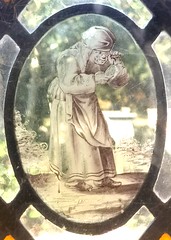
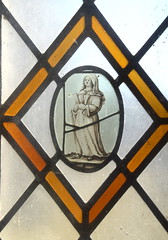
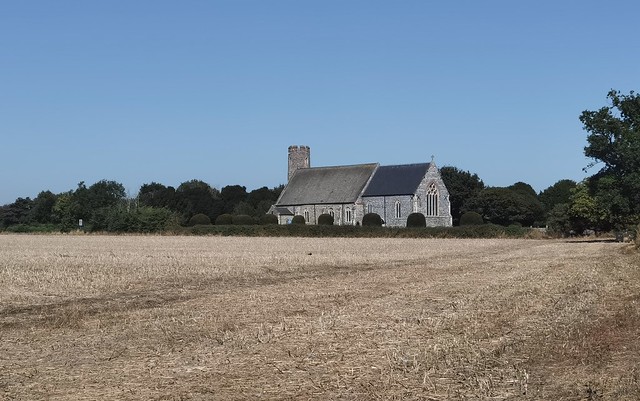
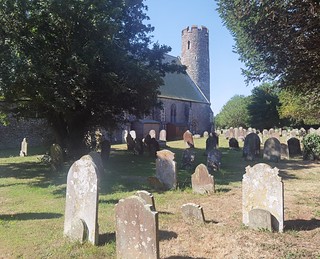
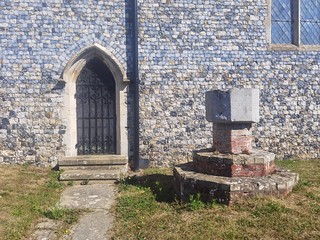
stairs to attack it... Charles Dickens, David Copperfield We're in the Lothingland Peninsula here, that wedge of Suffolk that sticks north in a vain attempt to keep Norfolk from the sea. Blundeston is closer to Lowestoft than to Great Yarmouth, but it is the journey to the Norfolk town that we remember from Dickens' book, when David goes with Pegotty to visit her family on the beach. Blundeston's population has grown recently as the former HMP Blundeston was replaced by housing, but in any case the church is out in the fields. The Norman round tower is taller than it first appears, because in the 14th Century its contemporary nave was rebuilt to the same height as the tower and much wider to the south, thus displacing the tower to the north. In the 15th Century some degree of dignity was restored when the tower was raised higher with a bell stage and battlements, and then the chancel was rebuilt to the same height as the nave in the 1860s. Even so, there is still a primitive air to the tower as it rises tapering beside the steeply banked roof of the nave, for all the world as if this were a Cornish tin mine or a Derbyshire mill. The south porch windows contain four 17th Century Netherlandish roundels of secular figures, the most memorable of which is an old woman wearing spectacles and reading a letter.
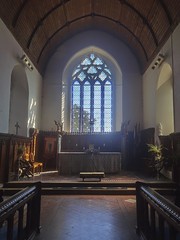
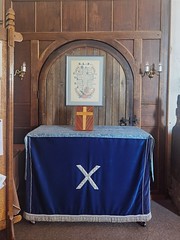
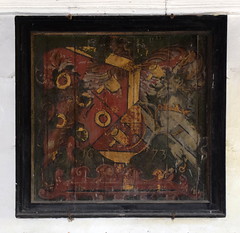
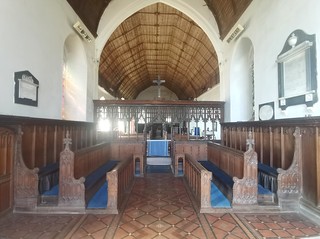
You step into a church which feels larger than it might appear from the outside, although the widening was accomplished with a need for an aisle or arcade. The octagonal font appears to be Norman, and is set on a colonnade of eight legs. Several of its sides have deep near-parallel grooves in them as if something sharp had been used to scrape lines, and it is likely that this is exactly what has happened. These lines are often found on or around fonts, and there are several accounts from the Middle Ages which suggest that some superstitious parishioners scraped dust and fragments from special places within churches for ritual purposes. It might be eaten or drunk in medicine and the like, and the dust was all the more powerful if it came from a sacred object like a font. This practice was of course frowned upon by the Church authorities, but often they had little control over what went on in the naves of churches. There's some evidence that it continued in some places even after the Reformation. There is a popular idea that the score lines are from arrows, swords or knives being sharpened, but this isn't so. An altar against the north wall is dedicated to St Andrew, in memory of the nearby former church at Flixton, which was destroyed in a storm early in the 18th Century. The font in the churchyard here comes from Flixton, too. Turning east, the overall effect is mostly late Victorian, for there were two considerable restorations here either side of the rebuilding of the chancel, the first replacing the furnishings, the second rebuilding the roofs. There are old survivals, a few bench ends, and the lower part of the screen, built up in 1928, has faint traces of angels, perhaps with Instruments of the Passion as at Hitcham. Above the south door, the 1675 arms of Charles II are curious. They have been reused as a hatchment, but the overpainting has either faded or been partially removed at some point to reveal the true origin. And the memorials? Well, I'm afraid there is no Mr Bodgers, late of this parish, and probably never was. The high-backed pews are all gone, and although the pulpit would certainly make an excellent castle, it came with the 19th Century restoration and post-dates Dickens's (and Copperfield's) time. The grass is still lush and green in the churchyard though, and there is the curiosity of a slate tomb chest, the like of which I don't think I've seen anywhere else in East Anglia. It remembers Edward Oscar Owles, who died in 1859. Young, Happy, Loving and Beloved, his inscription reads, A Tale that is Told. |
Simon Knott, September 2022
Follow these journeys as they happen at Last Of England Twitter.




|
||||||||||||||||||||||||||||||||||||||||||||||||||||||