| |
St
George sits in an area with some of the best
small churches in England, and so perhaps it is
not surprising that it is not a well-known
church. Neighbouring Bacton is a busy suburban
village, but Wyverstone is very much in the
foothills of a vanishing rural idyll. To cycle to
it through late summer fields that swell on
either side of the lane is like coming up for
air. And Wyverstone is lovely too, and one of its
delights is St George, a quirky little church,
with none other in Suffolk quite like it. The
setting is super. Whoever it is that lives in the
cottage to the south is very lucky indeed.
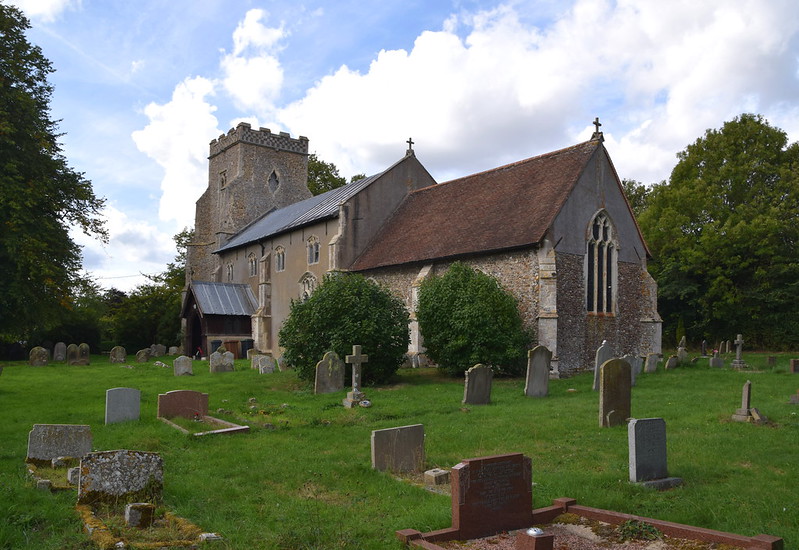
The 14th century tower has a wide eastern face,
and the high clerestory lifts against it.
However, there are no aisles, the clerestory
floating somewhat adrift, aand so the main
impression you get is one of height. This is a
tall, thin church, but on a small scale. The
wooden porch and gargoyles make it atmospheric,
thoroughly gothic. You step inside to light, not
surprisingly, given all the windows.
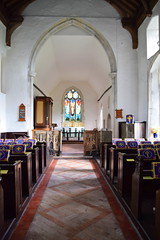
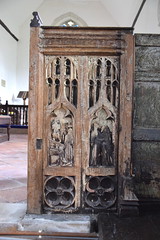
The star attraction here is the early 16th
century roodscreen. At first sight, it is a bit
battered, and everything above the dado has been
destroyed. But, here perhaps a century after the
majority of Suffolk screens had been installed
and painted, is the only rood screen in situ
in Suffolk where the figures are carved in
relief. And what a fascinating sequence they are!
There were once eight panels, four each side.
Only two of the panels on the south side survive,
the gap plugged by a piece of early 17th Century
panelling. On the north side are the Annunciation
to the Blessed Virgin, and what was probably the
Adoration of the Magi, although this last panel
has been particularly vandalised by Anglican or
Puritan vandals in the 16th or 17th century. All
that survives on the left is the base of the
stable and what might be a donkey feeding, with
the three headless figures in the right hand
panel, one of them kneeling.
On the south side, the southern panel is a
gorgeous Visitation, with Mary and Elizabeth both
voluptuously pregnant. These three scenes were
part of the common medieval rosary sequence - as,
indeed, they are today. The fourth panel, the
left hand one on the south side, is probably the
most interesting of all, since it portrays the
medieval legend of the Mass of St Gregory, which
was used as a comfort to those who found their
faith in the Eucharist shaken. St Gregory kneels
in the sanctuary, and the risen Christ appears in
bodily form on the altar above him. Assuming the
two lost panels were also intended to be rosary
meditations, they might have depicted the
Assumption of the Blessed Virgin or the
Coronation of the Queen of Heaven - this would
have marked them out as clear candidates for
destruction. It seems likely that the two
surviving panels on the south side were once to
the south of their present position, and the two
lost panels were beside the entrance to the
chancel, matching the Adoration of the Magi.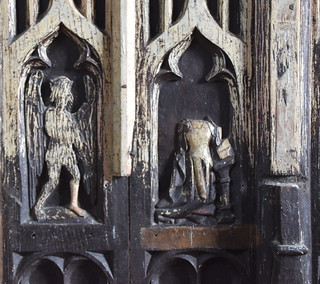 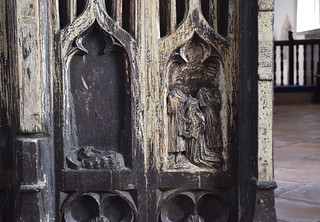 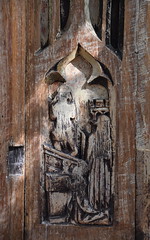 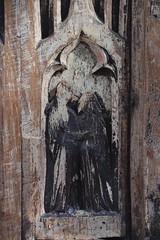
Curiously,
the panel that once formed the left hand side of
the Adoration of the Magi, and thus held the Holy
Family, has the ghost of a figure painted in the
background, and it is hard to know how or when
this happened. Was the panel replaced from
elsewhere? Was it painted after the destruction,
during the Marian years? Or, more excitingly, was
this roodscreen painted with figures before
the reliefs were added? The nature of the reliefs
suggests that they were intended for very late
medieval devotions, and they may indeed have
replaced a sequence of Saints.
Although this screen is remarkable, there are
several other features which are of interest.
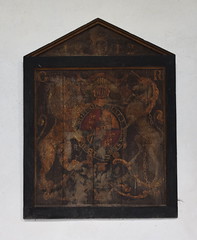
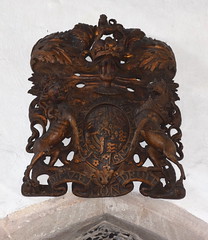
Wyverstone has two sets of royal arms, and
neither of them are run of the mill. On the west
wall of the nave is a richly carved and
ornamented set of arms for William III, dating
probably to the very first decade of the 18th
Century. Cautley thought it was the best set for
them in the country. Meanwhile, on the north wall
there is another set, ostensibly for George III,
and dated 1812. But look closely: The G is
floriated, and was almost certainly a C
originally. A couple of miles off at Westhorpe
there is a similar set, which, although clearly
painted by a different artist, have the same
triangular pediment, There, the arms are dated
1751, and are charged for George II, but showing
through the overcoat of paint are the letters C R
and the date 1602.
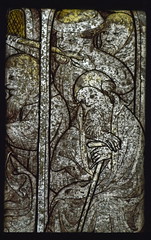
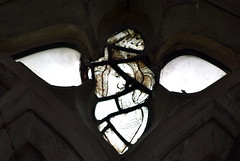
The screen is not the only medieval survival
here. High in the south window lights are four
ghostly figures, damaged composites so vague as
to hardly be there, until you notice that the
second one points with a finger at a missing
symbol, perhaps the instrument of their
martyrdom. In much better condition is a fragment
of a panel, probably continental, depicting the
Adoration of the Shepherds. Above it is a
fragmented and ghostly head of Christ.
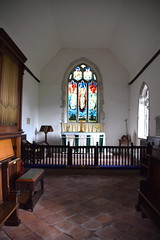
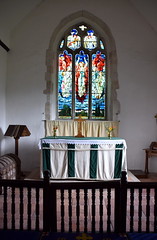
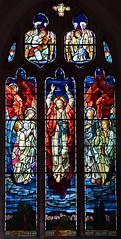
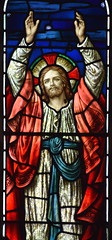
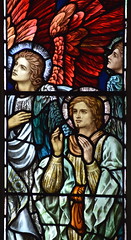
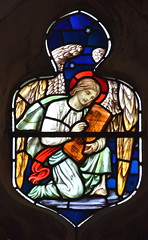
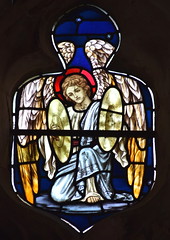
Rather less vague and fragmentary is the splendid
1926 east window by William Glasby, of the
Ascension of Christ adored by angels. Aidan Mcrae
Thompson tells me that the central figure of
Christ is a design Glasby reused in many of his
windows, including one at Ilston on the Gower
Peninsula identical to the centre light here. The
effect is something like the work of Henry
Holiday from three decades earlier, and it is not
surprising to learn that Glasby was a pupil of
Holiday's. The window is boldly sentimental, and
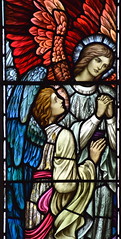
quite late for such confidence. The angels are
gorgeous, but the central figure of Christ looks
unfortunately as if he is reaching up to take
something down from a high shelf.
|
|
|